
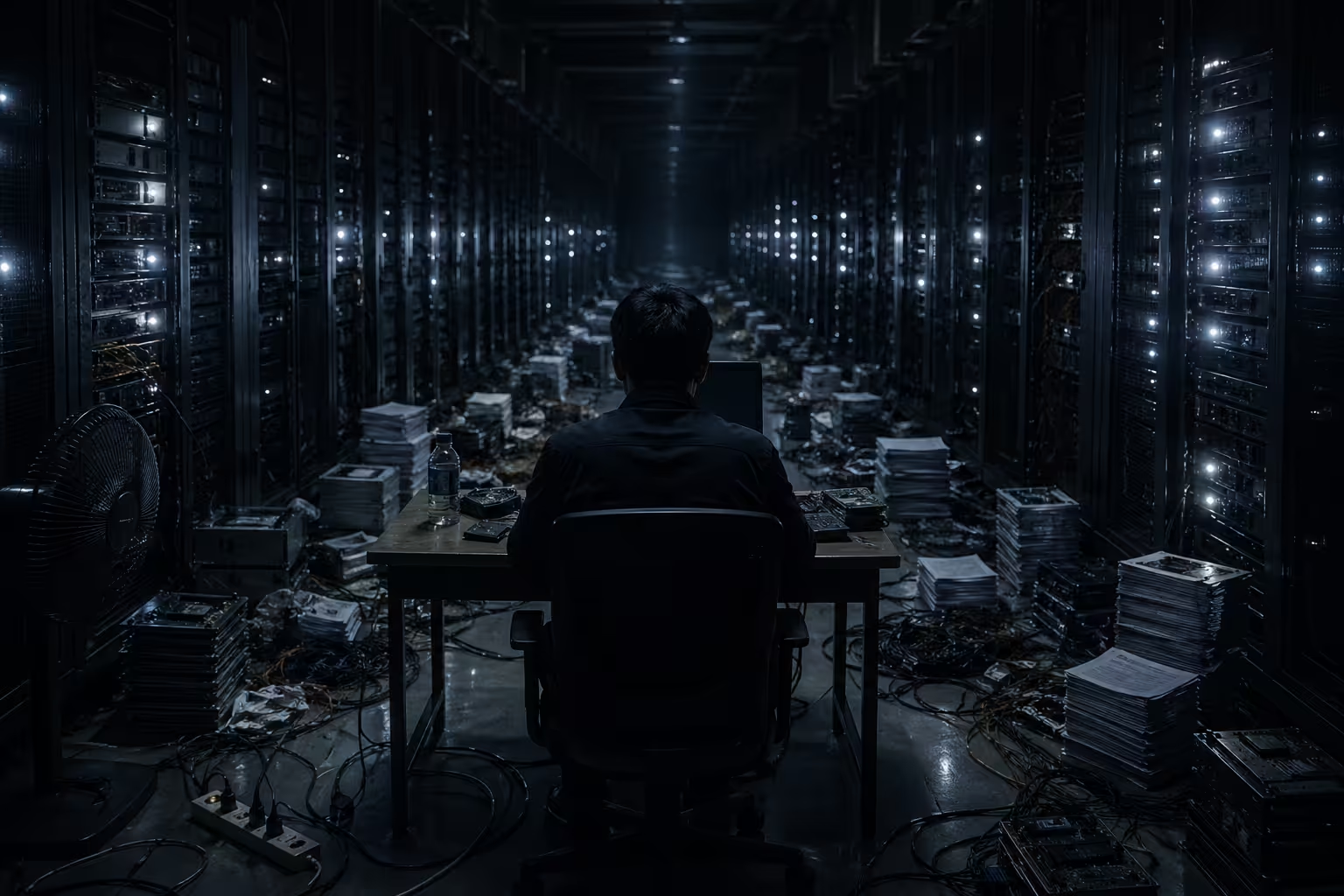
The Market Value of Hand-Typed Code Is Zero
The market value of the code you just typed by hand is zero.
If that realization does not keep you up at night, you are likely standing in the Dumb Zone without a map. We have transitioned from an era of syntax mastery to an era of intent orchestration. In early 2026, the software engineer’s prestige is no longer anchored in how fast they can talk to a machine, but in how effectively they can curate the artifacts that machines generate.
Andrej Karpathy’s “vibe coding” is not a meme. It is a movement toward Software 3.0: a paradigm where English is the hottest new programming language and large language models (LLMs) function as the new operating system. In this world, the prompt is the program and the model is the CPU.
This democratization comes with a massive, silent tax: the collapse of structural integrity.
The Friction: Jagged Intelligence and the Ghost House Effect
The vibe feels effortless until it collides with jagged intelligence: an AI can architect a distributed system and then fail at basic numerical logic.
When developers treat agents like black boxes, they create a Ghost House: a codebase that looks polished from the outside but is structurally hollow.
The primary friction in vibe coding is the Comprehension Gap.
- Developers commit code they cannot explain.
- Prompt history becomes the only architecture record.
- One manual edit can cascade into system-wide failure.
This is prompt-spaghetti: architectural logic exists only in a transient chat session.
The Dumb Zone
The Dumb Zone is the critical threshold where an agent’s context window exceeds 40% utilization. Beyond this point, an agent’s reasoning quality and instruction-following accuracy can drop by about 30%. It stops behaving like an architect and starts behaving like a forgetful apprentice.
Fact Check: The Security Reality
Data from the Veracode 2025 GenAI Code Security Report confirms a blunt truth: speed without curation is liability.
| Security Metric | AI-Generated Finding | vs. Human Baseline |
|---|---|---|
| Overall security failure rate | 45% of code samples | 1.57x more findings |
| Java (worst offender) | 72% security failure rate | Language-specific outlier |
| Logic/correctness errors | 1.75x more likely | 1.0x (standard) |
| Cross-site scripting (XSS) | 86% failure to defend | 2.74x more likely |
| Log injection vulnerabilities | 88% vulnerable | High incidence rate |
Insight: AI does not just make mistakes. It can replicate and scale vulnerabilities faster than human-only workflows.
The Synthesis: The Locuno Synergy Framework
To survive the death of implementation, the developer must move from writer to curator.
The Locuno Synergy Framework is a Narrowing Funnel: a system of filters that ensures only high-quality, verified code survives.
The Narrowing Funnel Workflow
- Intent: define the high-level goal and architectural constraints.
- Harness: encode executable standards with tests and linting rules.
- Generation: let the agent attempt implementation in a tight loop.
- Verification: filter output through Makefile and CI hooks.
- Curation: perform final diff review for project vibe and security profile.
The Curator’s Toolkit
- Orchestration: Cursor (Composer), Replit Agent 3, Claude Code.
- Harness: Makefile, Pint (PHP), Prettier, Psalm (static analysis), custom ESLint security plugins.
- Context: MCP (Model Context Protocol) servers for on-demand knowledge retrieval.
Architecture: The Three-Tier Memory Model
Context is the memory substrate of Software 3.0. To avoid context window paralysis and stay out of the Dumb Zone, elite curators use a tiered memory architecture.
Tier 1: Project Constitution (Hot Memory)
A root markdown file (often CLAUDE.md) that defines naming conventions, build commands, and project invariants.
Curator pro-tip: keep it under 1,000 lines. Beyond that, attention decay rises and instruction adherence drops.
Tier 2: Specialist Agents (Warm Memory)
Domain personas (for example, SQL optimizer, UX architect) loaded only when relevant files are touched. This keeps prompt focus high and noise low.
Tier 3: Knowledge Base (Cold Memory)
Large documentation sets and API specs retrieved on demand via MCP. The agent loads only what is needed for the current task.
The Horizon: The Sovereign Decision
The final strategic shift is understanding the difference between artifact and responsibility.
AI is paid for artifact. You are paid for responsibility.
A chef is not paid for the recipe, but for the responsibility of serving safe, high-quality food. In Software 3.0, you are the guarantor. AI can propose an implementation, but only a human can authorize it.
AI does not get fired when production goes down. AI does not lose reputation when a breach leaks user data. You do.
Your value in 2026 is no longer your ability to prompt a machine, because prompting is becoming commodity labor. Your value is sovereign judgment: the ability to inspect 10,000 lines of generated code and decide whether they represent a secure, scalable, and ethical path forward.
The keyboard is optional. Judgment is mandatory.
References
- The Curator’s Role: Managing a Codebase with an Agent (Tacoda, 2026).
- Codified Context: Infrastructure for AI Agents (arXiv:2602.20478).
- Veracode 2025 GenAI Code Security Report.
- The Impact of AI-Generated Code on Technical Debt (GoCrossbridge, 2026).
- Agentic Context Engineering: The 40% Threshold (arXiv, 2025).
- The Value of a Developer in the Age of AI (The Average Dev, 2026).
Sources
- https://www.reddit.com/r/ClaudeAI/comments/1sdwpye/the_ghost_house_effect_why_claude_code_feels_like/
- https://www.reddit.com/r/ExperiencedDevs/comments/1sosciu/saving_challenging_projects_was_my_niche_but_ai/
- https://riseuplabs.com/vibe-coding/
- https://www.techradar.com/pro/software-3-0-is-speeding-up-coding-but-delivery-is-a-different-story
- https://theaveragedev.com/the-value-of-a-developer-in-the-age-of-artificial-intelligence/
- https://en.wikipedia.org/wiki/Vibe_coding
- https://www.vincirufus.com/en/posts/software-3-0-age-of-ai/
- https://super-agentic.ai/resources/super-posts/software-3-0-software-is-changing-again-and-again/
- https://roadmap.sh/vibe-coding/best-tools
- https://medium.com/superagentic-ai/software-3-0-software-is-changing-again-and-again-af0c5cce786e
- https://replit.com/discover/best-vibe-coding-tools
- https://www.tanium.com/blog/what-is-vibe-coding/
- https://arxiv.org/html/2602.20478v1
- https://alexlavaee.me/blog/harness-engineering-why-coding-agents-need-infrastructure/
Published at: Apr 25, 2026 · Modified at: May 5, 2026

Related Posts

Digital Minimalism at Work: How to Protect Your Focus in the Age of AI Noise

In the Age of AI Slop, Curation Is the New Superpower